BROOKS INSTRUMENT SLA5850S1EAF4C2A1 Flow Controller Slph 500 H2
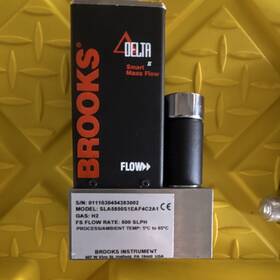
( Brand: Brooks Instrument ), ( Manufacturer Part Number: SLA5850S1EAF4C2A1 ), ( Part Type: Flow Instrument Controller ), ( Maximum Flow Rate: 500 Slph ), ( Gas Media: H2 Hydrogen )
Review BROOKS INSTRUMENT Mass Flow Controller 500 Slph H2
The **Brooks Instrument SLA5850S1EAF4C2A1 Flow Controller** is a high-performance, mass flow controller designed to deliver unparalleled precision and reliability in demanding gas and liquid applications. Part of Brooks renowned SLA5850 series, this advanced device integrates a robust thermal mass flow sensor with a proportional valve actuator, ensuring accurate and repeatable flow regulation across a wide range of operating conditions. Engineered for applications requiring tight control such as research laboratories, semiconductor manufacturing, or specialized industrial processes this flow controller excels in maintaining consistent flow rates with minimal drift, even under fluctuating pressure or temperature variations. The unit is equipped with a **500 standard liters per hour (SLPH) flow capacity**, making it ideal for medium to high-volume applications where efficiency and accuracy are critical. Its **corrosive-resistant materials**, including stainless steel construction and compatible seals, ensure long-term durability in harsh environments, while the **digital interface** provides seamless integration with PLCs, DCS systems, or standalone controllers for real-time monitoring and adjustment. The SLA5850S1EAF4C2A1 also features **adaptive control algorithms** that optimize performance by dynamically compensating for environmental factors, reducing the need for manual calibration. Whether used in gas delivery systems, chemical processing, or precision instrumentation, this flow controller combines cutting-edge technology with rugged engineering to deliver consistent, high-fidelity flow control with minimal maintenance requirements.
**Pros and Cons of buying a Brooks SLA5850S1EAF4C2A1 Flow Controller (500 SLPM, H )**
### **Pros**
1. **High Precision and Reliability** The Brooks SLA5850 series is known for its accuracy in mass flow control, making it suitable for applications requiring precise gas delivery, such as hydrogen (H ) systems, research labs, or industrial processes.
2. **Wide Flow Range** With a maximum flow rate of 500 standard liters per minute (SLPM), this controller can handle moderate to high-volume applications, including pilot-scale experiments or small-scale industrial setups.
3. **Compatibility with Hydrogen (H )** The unit is explicitly designed for hydrogen service, which is critical for applications in fuel cell testing, hydrogen purification, or other high-purity gas systems.
4. **Digital Control and Communication** The model features digital control capabilities, allowing for integration with PLCs, DCS, or lab automation systems via communication protocols (e.g., Modbus, Profibus, or analog signals).
5. **Durability and Build Quality** Brooks is a well-established brand in industrial gas control, and this unit is built to withstand demanding environments, reducing long-term maintenance needs.
6. **Adjustable Pressure Range** The controller can operate across a range of pressures, providing flexibility for different system requirements without needing multiple units.
7. **Low Leakage and High Efficiency** The design minimizes internal leakage, ensuring that gas is delivered efficiently without significant waste.
8. **Easy Calibration and Maintenance** Brooks controllers are generally user-friendly, with straightforward calibration procedures and replaceable components where necessary.
9. **Safety Features** The unit likely includes safety mechanisms such as over-pressure protection and flow limiting to prevent system failures.
10. **Compatibility with Various Gases** While optimized for hydrogen, it can also be used with other clean, non-corrosive gases like nitrogen, argon, or helium, depending on the configuration.
---
### **Cons**
1. **High Initial Cost** Brooks flow controllers are premium products, and this model will likely be more expensive than basic mechanical or digital alternatives, especially from lesser-known brands.
2. **Complexity for Non-Experts** The digital interface and advanced features may require training to operate effectively, which could be a drawback for users without prior experience with mass flow controllers.
3. **Maintenance Requirements** While durable, regular calibration and occasional part replacements (e.g., seals, sensors) may be necessary, adding to long-term operational costs.
4. **Limited Portability** This is an industrial-grade unit, not designed for field use or easy relocation. It requires stable installation, which may restrict its flexibility.
5. **Power Dependency** The digital control system requires a power source, which could be a limitation in applications where battery-powered or standalone operation is needed.
6. **Potential for Overkill** If the application does not require the full 500 SLPM capacity or advanced digital features, a simpler or lower-cost controller might suffice.
7. **Warranty and Support Costs** While Brooks offers strong support, warranty claims or authorized service may incur additional expenses, especially if the unit is used in harsh conditions.
8. **Learning Curve for Integration** If connecting to a custom system, users may need to invest time in programming or configuring the controller with their existing setup.
9. **Size and Space Requirements** The unit is not compact, so installation may require dedicated space, which could be a constraint in lab or field settings.
10. **Potential for Obsolescence** Industrial equipment can become outdated over time, and future upgrades or replacements may require compatibility checks with newer systems.
---
### **Conclusion**
The **Brooks SLA5850S1EAF4C2A1** is a high-quality, reliable mass flow controller well-suited for applications requiring precise hydrogen gas control, such as research labs, fuel cell testing, or industrial processes where accuracy and durability are critical. Its advanced features, wide flow range, and compatibility with automation systems make it a strong choice for professional users who prioritize performance and integration.
However, the **high cost, complexity, and maintenance needs** may not justify the purchase for smaller-scale or less demanding applications. If budget or simplicity is a priority, alternative brands or simpler models might be more appropriate. For users with specific needs such as high-precision hydrogen delivery, long-term reliability, or system integration the Brooks controller remains a robust and dependable option.
### **Recommendation**
**Buy this unit if:**- You require precise mass flow control for hydrogen or other clean gases in a research, industrial, or semi-industrial setting.
- Your application demands integration with automation systems (PLCs, DCS, etc.) or digital monitoring.
- You can justify the higher upfront cost with long-term reliability and reduced risk of system failures.
- The 500 SLPM capacity and pressure range align with your operational needs.
**Consider alternatives if:**- Your application only requires low to moderate flow rates (e.g.,
- You lack technical expertise to operate or maintain advanced digital flow controllers.
- Budget constraints make the Brooks unit prohibitively expensive compared to other brands with similar performance.
- Portability or field use is a priority, as this is an industrial-grade unit designed for fixed installations.
For most **professional, high-precision gas control applications**, the Brooks SLA5850 is a **strong recommendation**. For smaller or less demanding setups, evaluating cost-effective alternatives (e.g., other Brooks models, Bronkhorst, or Aalborg) may be advisable.
Details:
Brooks Instrument SLA5850S1EAF4C2A1 Mass Flow Controller 500 SLPH H2.
part #: sla5850s1eaf4c2a1 price
- $171.00
specifications pneumativalv:
- brand: Brooks Instrument
- mpn: Sla5850s1eaf4c2a1
- part type: Flow Instrument Controller
- maximum flow rate: 500 Slph
- gas media: H2 Hydrogen
offer pneumativalv:
- sold: 0
- quantity: 1
- availability: In Stock
- best offers: True
- options: Ship-to-home
- started: March 24, 2026
payments pneumativalv:
- other
- wallet: Google-pay
- credit card: Discover
shipping pneumativalv:
- carrier: USPS
- transit: 4-10 Days
- type: Calculated
- class: Standard
- cost: $10.41
- service: USPS Ground Advantage
returns pneumativalv:
- policy: No Returns
general pneumativalv:
- condition: Used
- Pump Flow Controllers > Flow Controllers Meters > Mass Flow Controllers
seller pneumativalv:
- rating: 0.0%
- city: Katy, Texas
- # reviews: 0
Brooks Instrument SLA5850S1EAF4C2A1 Is Similar To:
- 0151aad2a11a Brooks Instrument Flow Computer (50% similar) Includes what is in the pics. Brooks Instrument 0151AAD2A11A flow controller. Used working pull, see all 12 pics for details...(June 9th, 2018)
- 0152-ee2a11a Brooks Instrument Mass Flow Meter Readout (52.5% similar) Brooks 0152E model mass flow controller meter readout UNIT2-CHANNELS comes with power cord full number: 0152 EE2A11ASERIAL 370...(May 12th, 2018)
- 0152e Brooks Instrument Microprocessor Control Readout Unit (50.4% similar) Unit has wear from previous use including scuffs and scratches. Ready to ship today. Photos of actual item for sale. Unit only, no power cable or accessories included. Brooks 0152E microprocessor control readout unit has been tested onsite and is guaranteed fully functional...(November 8th, 2018)
- 0154 Brooks Instrument Microprocessor Flow (47.3% similar) Pulled from a pilot unit we decommissioned. Up for sale is a Brooks Instrument microprocessor control read out unit model panel mounted design. You can reach us by phone at extension 106 or messaging through...(December 14th, 2017)
- 0154bbc2a11a Brooks Instrument Microprocessor Mass Read Out Control Electronics (49% similar) Boxes is on a case by basis. The readout function is a back lit 4 x 20 character display. Please see pictures for reference. Signal OUTPUT0 1 5 CDC or ma, impedance kw minimum 750W maximum electrical two four 15-PINCONNECTORS for connecting the mass flow pressure control equipment. One 15-...(July 28th, 2018)
- 0154cfc2a11a Brooks Instrument Read Out Control Electronics (50.4% similar) Unit has minor scuffs and scratches from previous use handling. Photos of actual item for sale. Ready to ship today. Unit only, no power cable or accessories included. Brooks Instrument 0154 0154CFC2A11A read out control electronics unit has been tested onsite and is guaranteed fully functional...(December 11th, 2018)
- 0154cfd2b31a Brooks Instrument Read Out Control Electronics (50.4% similar) They are expected to show some wear as pre-owned. Brooks Instrument 0154CFD2B31A read out control electronics hello, you are viewing a listing of product wood man mechanical surplus. Exactly what is pictured included. If it is not pictured assume included...(January 12th, 2019)
- 0190-32365-04 Brooks Gf 125cxxc Mass (26.9% similar) Smaller items will normally ship USPS and heavier FedEx ground...(October 23rd, 2017)
- 0190-40282-01 Brooks Gf Mass Thermal Flow Controller Amat (48% similar) Used excellent condition Brooks GIF 125CXC mass thermal flow controller Amati in: 9B800-9-18...(September 7th, 2018)
- 0190-49895-01 Brooks Gf 125cxxc Mass (26.9% similar) Smaller items will normally ship USPS and heavier FedEx ground...(October 23rd, 2017)
- 0254aa1a23a Brooks Channel Power Supply Readout Setpoint Controller (37% similar) Shipping is for USA deliveries only...(May 25th, 2018)