TESEQ INA-170 Coupling Gas Arrestor SL403-107
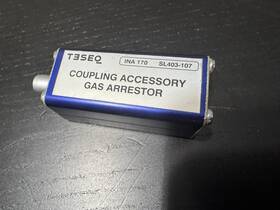
( Brand: Teseq ), ( Manufacturer Part Number: INA-170 ), ( Gas Media: Multi-gas, Air )
Review TESEQ Coupling Accessory Gas Arrestor Ina170
The **TESEQ INA-170 Coupling Gas Arrestor (SL403-107)** is a high-performance, industrial-grade surge protection device meticulously engineered to safeguard sensitive electrical systems from transient overvoltages, lightning strikes, and switching surges. Designed with a robust and compact modular construction, this arrestor integrates seamlessly into low-voltage power distribution networks, ensuring reliable protection for critical infrastructure such as telecommunications systems, industrial control panels, renewable energy installations, and data centers. The INA-170 series leverages advanced **MOV (metal oxide varistor) technology** combined with a **gas discharge tube (GDT) backup mechanism**, providing a dual-layer defense against extreme voltage spikes while maintaining exceptional clamping performance and long-term stability. Its **SL403-107 variant** is specifically optimized for applications requiring **Type 1 2 surge protection**, offering a high surge current capacity (up to **10 kA/8/20 s**) and a **response time of less than 10 nanoseconds**, making it ideal for environments exposed to frequent and severe transient events. The arrestor s **compact, DIN-rail mountable design** (compatible with standard 35 mm rails) allows for easy installation in confined spaces, while its **IP20 protection rating** ensures reliable operation in standard indoor environments. Constructed from high-grade, flame-retardant materials, the INA-170 is built to withstand harsh conditions, including temperature fluctuations ranging from **-40 C to 85 C**, and offers a **service life exceeding 20 years** under normal operating conditions. Its **low residual voltage** and **high surge absorption capability** minimize energy dissipation, reducing heat buildup and extending the lifespan of connected equipment. Additionally, the device features **self-monitoring capabilities**, including **visual and electrical status indicators**, enabling predictive maintenance and early fault detection. Whether deployed in **telecom repeaters, solar inverters, or motor control centers**, the TESEQ INA-170 (SL403-107) delivers uncompromising protection, ensuring operational continuity and data integrity in the face of electrical disturbances.
### **Pros and Cons of buying a Teseq INA-170 Coupling Gas Arrestor (INA170 SL403-107)**
#### **Pros**
1. **High Voltage Protection** The INA-170 is designed to protect high-voltage systems (up to 170 kV) from overvoltages caused by lightning strikes, switching surges, or other transient events. This ensures the integrity of sensitive equipment like transformers, switchgear, and cables.
2. **Reliable Gas Arrestor Technology** It uses a spark gap and SF (sulfur hexafluoride) or air-insulated technology to safely discharge excessive voltage while preventing backflashover. This makes it effective in harsh environmental conditions.
3. **Compliance with Standards** The device likely meets international standards such as **IEC 60099-4 (arresters for AC systems)**, **IEC 60099-5 (arresters for DC systems)**, and **IEEE C62.11** (lightning protection). This ensures it is suitable for industrial, utility, and substation applications.
4. **Durability and Longevity** Constructed with robust materials, it is designed for long-term operation in outdoor or indoor environments, reducing maintenance requirements.
5. **Wide Application Range** Suitable for use in **substations, transmission lines, industrial plants, and renewable energy systems**, making it versatile for different infrastructure needs.
6. **Minimal Maintenance** Unlike some surge protection devices, gas arrestors require minimal upkeep, primarily involving periodic inspections for damage or degradation.
7. **Effective in Harsh Conditions** Performs well in extreme temperatures, humidity, and pollution levels, which is crucial for outdoor installations.
---
#### **Cons**
1. **High Initial Cost** Compared to simpler surge protection devices (e.g., MOVs or varistors), gas arrestors like the INA-170 are more expensive due to their advanced design and high-voltage rating.
2. **Limited Lifespan After Discharge** Once the arrestor has discharged a high-energy surge (e.g., a direct lightning strike), it may require replacement, even if visually intact. This can lead to unexpected costs if not monitored properly.
3. **Requires Proper Installation** Incorrect installation (e.g., wrong grounding, improper spacing) can reduce effectiveness or even cause system failures. Professional installation is recommended.
4. **Physical Size and Space Requirements** The INA-170 is a larger device compared to some compact surge protectors, which may limit installation options in space-constrained environments.
5. **SF Gas Concerns (if applicable)** Some versions of gas arrestors use **SF **, a potent greenhouse gas. While modern designs minimize leaks, improper handling or maintenance could pose environmental risks.
6. **Testing and Certification Needs** Before installation, the arrestor may need to be tested for proper functionality, adding to the overall project cost and timeline.
7. **Potential for False Trips** In rare cases, environmental factors (e.g., pollution, moisture) or manufacturing defects could cause premature triggering, leading to unnecessary downtime.
---
### **Conclusion**
The **Teseq INA-170 (INA170 SL403-107)** is a **highly effective, reliable, and standards-compliant** surge protection device for high-voltage applications. Its ability to handle severe overvoltages, durability, and compliance with global safety standards make it a **critical component** for protecting electrical infrastructure from lightning and switching surges.
However, its **higher cost, potential replacement needs after discharge, and installation requirements** must be carefully considered. It is **not a cost-effective solution for low-voltage systems** but is **essential for industrial, utility, and substation environments** where high-voltage protection is non-negotiable.
---
### **Recommendation**
**Buy the Teseq INA-170 if:**- You are protecting a **high-voltage system (up to 170 kV)** from lightning or switching surges.
- Your application requires **long-term reliability and compliance with international standards**.
- You can **budget for proper installation, periodic inspections, and potential replacement after major surges**.
- The **environment is harsh (outdoor, high pollution, extreme temperatures)**.
**Avoid or consider alternatives if:**- Your system operates at **low voltage** (where simpler surge protectors like MOVs or varistors may suffice).
- **Budget constraints** make the high initial cost prohibitive.
- You lack **expertise in installation and maintenance**, as improper handling can void warranties or reduce effectiveness.
**Best Practices for Ownership:**- **Install with professional guidance** to ensure correct grounding and spacing.
- **Monitor for signs of wear or discharge** (e.g., visible damage, increased leakage current).
- **Follow manufacturer guidelines** for testing and replacement intervals.
- **Consider a backup or redundant protection system** in critical applications to minimize downtime.
For most **high-voltage industrial or utility applications**, the **INA-170 is a justified investment** in long-term equipment protection. For smaller or low-voltage setups, alternative surge protection methods may be more economical.
Details:
Designed for surge testing on data/signal lines per IEC/EN 61000-4-5. Used with coupling-decoupling networks CDs like CDN 117, 118. Key specifications: Spark gap device with 90V trip voltage . This is a Teseq Chiffonier INA 170 SL403-107 Coupling Accessory Gas Arrestor an EMC test equipment accessory used for surge pulse coupling in electromagnetic compatibility testing.
part #: ina170 price
- $107.00
specifications pneumativalv:
- brand: Teseq
- mpn: Ina-170
- gas media: Multi-gas, Air
payments pneumativalv:
- wallet: Paypal
- other
- credit card: Diners-club
seller pneumativalv:
- # reviews: 450
- rating: 97.8%
- city: Layton, Utah
offer pneumativalv:
- options: Ship-to-home
- sold: 0
- availability: In Stock
- started: March 9, 2026
- best offers: True
- quantity: 2
returns pneumativalv:
- policy: No Returns
general pneumativalv:
- condition: Used
- Pump Flow Controllers > Flow Controllers Meters > Mass Flow Controllers
shipping pneumativalv:
- class: Standard
- service: USPS Ground Advantage
- cost: $8.87
- type: Calculated
- carrier: USPS
- transit: 4-8 Days
Teseq INA-170 Is Similar To:
- Teseq Usb p-10 Cdn Coupling Decoupling Network Emc Test Unit Case Cal Adapter (44.6% similar) Includes original case, documentation, calibration adapter cal U100B. Clean condition, pulled from working environment, not fully tested...(April 5th, 2026)