HUMONICS INC HFM-520 Agilent Optiflow Digital Volumetric Bubble Inc. Flowmeter
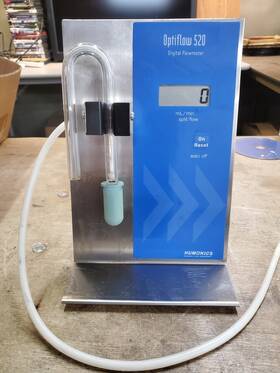
( Brand: Humonics Inc ), ( Manufacturer Part Number: HFM-520 ), ( Part Type: Digital ), ( Flow Meter Type: Volumetric ), ( Unit Type: Unit ), ( Minimum Flow Rate: 0.5 Ml/min ), ( Maximum Flow Rate: 500 Ml/min ), ( Country Of Origin: China )
Review HUMONICS INC Inc. Agilent Optiflow 520 Digital Volumetric Bubble Flowmeter Tested
The **Humonics HFM-520 (Agilent OptiFlow 520) Digital Volumetric Bubble Flowmeter** is a high-performance, precision-engineered instrument designed to deliver unparalleled accuracy and reliability in the measurement of gas flow rates, particularly in applications where bubble flow dynamics play a critical role. This advanced flowmeter operates on the principle of volumetric displacement, utilizing a specialized sensor assembly to detect and quantify individual gas bubbles as they pass through a transparent measurement chamber. The HFM-520 is engineered with a robust, corrosion-resistant construction, making it ideal for demanding environments such as laboratory settings, pharmaceutical manufacturing, biotechnology, and industrial gas processing where consistency and precision are paramount.
At the heart of the HFM-520 lies its **OptiFlow technology**, a proprietary system that combines optical sensing with digital signal processing to achieve exceptional repeatability and low detection limits. The flowmeter s transparent measurement tube, typically made from high-grade glass or polymer, allows for real-time visualization of bubble flow, ensuring that operators can monitor flow patterns and detect anomalies with ease. The integrated digital interface provides instantaneous readings of flow rate, totalized volume, and other key parameters, all of which are displayed with high resolution on an intuitive LCD screen. Additionally, the HFM-520 supports configurable alerts and thresholds, enabling automated responses to deviations in flow conditions, thereby enhancing operational efficiency and reducing the risk of errors.
One of the standout features of the HFM-520 is its **versatility in application**, accommodating a wide range of gases, including air, nitrogen, oxygen, and inert gases, across flow rates from ultra-low levels to moderate volumes. The flowmeter s modular design allows for easy calibration and maintenance, with replaceable sensor components and a user-friendly setup that minimizes downtime. Its compact yet sturdy housing ensures seamless integration into existing systems, whether in bench-top laboratory configurations or as part of a larger automated process control setup. Furthermore, the HFM-520 is compatible with industry-standard communication protocols, enabling seamless data logging, remote monitoring, and integration with SCADA or LIMS systems for comprehensive process tracking.
For researchers and engineers who demand the highest standards of accuracy and reliability, the HFM-520 delivers a blend of cutting-edge technology and practical functionality. Its ability to provide precise volumetric measurements with minimal drift or signal noise makes it an invaluable tool for applications requiring strict adherence to regulatory standards, such as those in the pharmaceutical or semiconductor industries. Whether used for batch processing, quality control, or experimental research, the Humonics HFM-520 (Agilent OptiFlow 520) sets a new benchmark for digital volumetric bubble flow measurement, offering a robust, efficient, and future-proof solution for gas flow analysis.
### **Pros and Cons of the Humonics HFM-520 (Agilent OptiFlow 520) Digital Volumetric Bubble Flowmeter**
#### **Pros**
1. **High Accuracy and Precision**
The HFM-520 is known for its high-precision volumetric measurement, making it suitable for applications requiring strict flow control, such as laboratory gas delivery, chromatography, and analytical processes. Its digital output ensures reliable data logging and repeatability.
2. **Wide Flow Range**
It supports a broad range of flow rates, from very low (micro-liter per minute) to higher volumes, depending on the gas and configuration. This versatility makes it adaptable to various experimental setups without requiring multiple flowmeters.
3. **Digital Output and Integration**
The device provides digital signals (e.g., RS-232, USB, or analog outputs) that can be easily interfaced with computers, data acquisition systems, or laboratory automation software. This simplifies data collection and real-time monitoring.
4. **Low Pressure Drop**
Unlike mechanical flowmeters, the bubble flowmeter minimizes pressure loss in the system, which is beneficial for sensitive applications where maintaining stable downstream pressure is critical.
5. **Compatibility with Multiple Gases**
It can measure a wide range of gases (e.g., nitrogen, argon, helium, air) without requiring recalibration, provided the viscosity and thermal conductivity are accounted for in the setup.
6. **Compact and Portable Design**
The HFM-520 is relatively compact, making it easy to integrate into benchtop or portable laboratory setups. Its modular design allows for flexible installation in existing gas delivery systems.
7. **Long-Term Stability**
With proper maintenance, the flowmeter maintains consistent performance over extended periods, reducing the need for frequent recalibration.
8. **User-Friendly Interface**
The digital display and intuitive controls make it accessible for both technicians and researchers, even those with limited experience in flow measurement.
---
#### **Cons**
1. **Limited High-Pressure Capability**
The HFM-520 is typically designed for low to moderate pressure applications (usually below 100 psi). For high-pressure gas delivery (e.g., industrial or cryogenic systems), alternative flowmeters (such as turbine or mass flowmeters) may be more suitable.
2. **Temperature Sensitivity**
While it performs well within standard laboratory temperature ranges, extreme temperature fluctuations can affect accuracy. Some models may require thermal compensation or stabilization for optimal performance.
3. **Maintenance Requirements**
The bubble flowmeter relies on a liquid column (often water or oil) to measure gas flow. Over time, contamination, evaporation, or liquid level fluctuations can degrade performance. Regular cleaning and refilling of the liquid reservoir are necessary.
4. **Slower Response Time for Rapid Flow Changes**
Due to its mechanical nature (bubble movement through a liquid column), it may not respond as quickly as electronic mass flowmeters to sudden flow rate variations. This can be a limitation in dynamic or pulsed flow applications.
5. **Cost of Replacement Parts**
While the HFM-520 itself is relatively durable, replacement of internal components (e.g., seals, liquid reservoirs, or sensors) can be costly. Some proprietary parts may require sourcing from the manufacturer.
6. **Limited Turndown Ratio in Some Configurations**
While it handles a wide range, extremely low flow rates (e.g., sub-microliter per minute) may require specialized setups or additional calibration, reducing its effectiveness in ultra-low-flow applications.
7. **Potential for Condensation Issues**
In humid environments or when measuring gases with high moisture content, condensation in the flowmeter can occur, leading to inaccurate readings or damage. Proper drying or heating of the gas may be necessary.
8. **Learning Curve for Advanced Features**
While basic operation is straightforward, fully utilizing advanced features (e.g., data logging, scripting, or integration with software) may require familiarity with the accompanying software or manual calibration procedures.
---
### **Conclusion**
The **Humonics HFM-520 (Agilent OptiFlow 520)** is a robust, accurate, and versatile digital volumetric bubble flowmeter ideal for laboratory applications where precision, digital integration, and low-pressure operation are prioritized. Its strengths lie in its high accuracy, wide flow range, and ease of use, making it a preferred choice for gas delivery in analytical chemistry, chromatography, and research settings.
However, its limitations such as temperature sensitivity, maintenance needs, and reduced suitability for high-pressure or dynamic flow applications must be carefully considered. If your application involves **low to moderate pressure, stable flow conditions, and the need for precise volumetric measurement**, this flowmeter is an excellent investment. For **high-pressure, high-speed, or industrial applications**, alternative technologies (e.g., mass flowmeters, thermal dispersion meters) may be more appropriate.
---
### **Recommendation**
**Buy the HFM-520 if:**- You require **high-accuracy volumetric flow measurement** in a laboratory or research setting.
- Your gas delivery system operates at **low to moderate pressures** (below 100 psi).
- You need **digital integration** with data acquisition or automation software.
- Your application involves **stable, non-pulsed gas flows** (e.g., carrier gases in GC, sample introduction in mass spectrometry).
- You can **maintain the flowmeter properly** (regular liquid refills, cleaning, and calibration).
**Avoid or consider alternatives if:**- You need **high-pressure or cryogenic gas flow measurement** (opt for a mass flowmeter).
- Your system involves **rapid flow changes or pulsed flows** (electronic mass flowmeters may be better).
- You operate in **extreme temperature environments** without thermal stabilization.
- Your budget is constrained, as replacement parts or advanced features may add long-term costs.
For most **analytical and research laboratories**, the HFM-520 remains a **highly reliable and cost-effective choice** when used within its intended specifications. Pair it with proper gas conditioning (e.g., drying, filtration) and maintenance protocols to ensure optimal performance.
Details:
The last calibration date is 2001. To test, we inserted a 9V battery as shown, and the meter powered on. Condition is good with normal signs of previous use as shown. The 9V battery shown is our test and not Included.
Specs found online: Accuracy 3%, Manufactured by Humonics, Flow rate 0.5-500 ml/min, Powers from 9V battery, Stainless Steel. We didn't test further but expect this item to work properly.
part #: hfm520 price
- $349.95
specifications pneumativalv:
- brand: Humonics Inc
- mpn: Hfm-520
- part type: Digital
- flow meter type: Volumetric
- unit type: Unit
- minimum flow rate: 0.5 Ml/min
- maximum flow rate: 500 Ml/min
- country of origin: China
general pneumativalv:
- Pump Flow Controllers > Flow Controllers Meters > Flow Meters
- condition: Used
returns pneumativalv:
- policy: Returns Accepted
- time: 60 Days
- method: Money back
- paid by: Buyer
payments pneumativalv:
- other
- wallet: Paypal
- credit card: Visa
offer pneumativalv:
- sold: 0
- availability: In Stock
- options: Ship-to-home
- quantity: 1
- started: April 18, 2026
seller pneumativalv:
- # reviews: 16249
- rating: 99.7%
- city: Springfield, Vermont
shipping pneumativalv:
- class: Standard
- carrier: USPS
- transit: 6-10 Days
- service: USPS Ground Advantage
- type: Calculated
- cost: $0.00