ITT BARTON FQ111 Fq Flow Totalizer First Rate
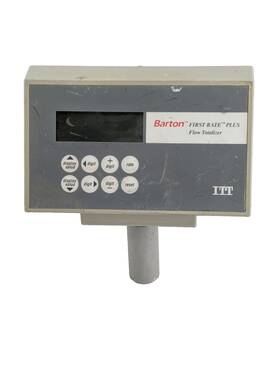
( Brand: Itt Barton ), ( Manufacturer Part Number: FQ111 ), ( Part Type: Flow ), ( Country Of Origin: United States )
Review ITT BARTON Fq Flow Totalizer First Rate Plus
The **ITT Barton FQ111 FQ Flow Totalizer** is a robust and precision-engineered flow measurement and totalization system designed to deliver unparalleled accuracy and reliability in industrial fluid handling applications. Part of ITT Barton s renowned line of flow measurement solutions, this unit combines advanced mechanical and electronic technologies to provide real-time flow monitoring, cumulative totalization, and data logging capabilities, making it an indispensable asset for industries such as oil and gas, water treatment, chemical processing, and manufacturing. Built with a durable cast aluminum housing, the FQ111 is engineered to withstand harsh environmental conditions, including extreme temperatures, high-pressure environments, and exposure to corrosive fluids, ensuring long-term operational integrity. Its compact yet sturdy design allows for seamless integration into existing piping systems, whether in above-ground or underground installations, while its modular construction simplifies maintenance and calibration procedures.
At the heart of the FQ111 lies its **FQ flow element**, a high-performance turbine meter that operates on the principle of angular momentum, where fluid flow spins a precision-balanced rotor within the meter body. The rotor s rotational speed is directly proportional to the flow rate, and this motion is transmitted via a magnetic coupling to a mechanical or electronic totalizer mechanism. The unit s **First Rate** designation underscores its exceptional accuracy, with a typical repeatability of 0.1% and a linearity error of less than 0.25%, ensuring consistent and dependable measurements even under fluctuating flow conditions. For applications requiring digital output, the FQ111 can be paired with optional electronic modules, such as the **FQ111-E** version, which provides pulse, analog (4-20 mA), or digital (RS-485/Modbus) signals for seamless integration with SCADA systems, data loggers, or PLCs. This flexibility makes it ideal for both standalone and networked applications where remote monitoring and automation are critical.
The FQ111 s **totalization system** is equally sophisticated, featuring a robust mechanical counter or an electronic display (depending on the model) that accumulates flow data in real time. The unit can be configured to measure and display flow rates in various units, including gallons per minute (GPM), cubic meters per hour (m /h), barrels per day (BPD), or any other customizable unit, catering to diverse industry standards. For enhanced functionality, the FQ111 supports **differential pressure compensation**, allowing it to adjust for variations in fluid density or pressure drop across the meter, thereby maintaining accuracy across a wide range of operating conditions. Additionally, its **zero-suppression feature** eliminates the need for manual adjustments when measuring low flow rates, further enhancing its versatility.
Safety and ease of use are prioritized in the FQ111 s design. The unit is equipped with a **non-contact magnetic coupling**, eliminating the risk of seal failure or fluid contamination while reducing maintenance requirements. Its **explosion-proof** and **intrinsically safe** certifications (depending on the model) ensure compliance with stringent industrial safety standards, making it suitable for use in hazardous environments such as refineries, petrochemical plants, or offshore platforms. The FQ111 also features a **backlit digital display** (in electronic models) with adjustable contrast and a user-friendly interface, allowing operators to quickly access flow data, reset totals, or configure settings without extensive training. For applications demanding additional security, the unit can be fitted with a **password-protected display**, preventing unauthorized modifications to critical measurements.
Maintenance of the ITT Barton FQ111 is streamlined thanks to its **modular and accessible components**. The flow element, totalizer, and electronic modules can be serviced or replaced with minimal downtime, reducing operational disruptions. ITT Barton s reputation for quality extends to the unit s **long-term reliability**, with many FQ111 units operating reliably for decades with proper care. The manufacturer also provides comprehensive **calibration services**, ensuring that the meter maintains its high accuracy standards over time. Whether deployed in a critical production line, a water distribution system, or a research facility, the ITT Barton FQ111 FQ Flow Totalizer stands as a testament to engineering excellence delivering precision, durability, and performance where it matters most.
### **Pros and Cons of Buying an ITT Barton FQ111 FQ Flow Totalizer (First Rate)**
The ITT Barton FQ111 FQ Flow Totalizer is a mechanical flow measuring device commonly used in industrial applications for monitoring and totalizing fluid flow. Below is a detailed analysis of its advantages and disadvantages.
---
### **Pros**
1. **Reliability and Durability**
The FQ111 is a robust, mechanical device designed for harsh industrial environments. It is built to withstand high pressures, temperatures, and corrosive fluids, making it suitable for long-term use in oil, gas, water, and chemical processing industries.
2. **Mechanical Accuracy**
Unlike electronic flow meters, which can be affected by power fluctuations or signal interference, the FQ111 relies on a mechanical counting mechanism. This reduces the risk of electronic failures and provides consistent, dependable measurements over time.
3. **Low Maintenance Requirements**
Since it has fewer moving parts compared to some electronic systems, the FQ111 typically requires less frequent maintenance. Its simple design consisting of a turbine or propeller, a magnetic pickup, and a mechanical counter means fewer points of failure.
4. **No Power Dependency**
The device operates independently of electrical power, making it ideal for remote or off-grid locations where power supply is unreliable or unavailable. It can be used in emergency backup systems or standalone applications.
5. **Cost-Effective for Bulk Applications**
For applications where high-volume flow measurement is required (e.g., water distribution, fuel storage, or bulk chemical transfer), the FQ111 provides a cost-effective solution. Its mechanical nature reduces the need for expensive calibration or recalibration.
6. **Resistance to Signal Interference**
Electronic flow meters can be susceptible to electromagnetic interference (EMI) or radio frequency interference (RFI), which may distort readings. The FQ111 avoids this issue entirely due to its mechanical operation.
7. **Long Lifespan**
With proper installation and maintenance, the FQ111 can operate for decades, making it a sound long-term investment for industries where flow measurement is critical but not frequently monitored.
8. **Easy Installation and Calibration**
The device is relatively straightforward to install and calibrate, especially when compared to some advanced electronic meters. Many versions include built-in calibration features or allow for easy adjustment.
9. **Wide Range of Applications**
It is versatile and can be used in various fluids, including water, oil, gasoline, and certain chemicals, depending on the material of construction (e.g., stainless steel, bronze, or other alloys).
10. **First Rate Brand Reputation**
ITT Barton is a well-established brand with a history of producing reliable industrial equipment. The "First Rate" designation suggests it meets high-quality standards, which can be reassuring for buyers seeking dependable equipment.
---
### **Cons**
1. **Limited Precision for Low Flow Rates**
The FQ111 may struggle with accuracy at very low flow rates due to the mechanical nature of its counting mechanism. Turbulence or minor fluctuations in flow can lead to inaccuracies in readings.
2. **Susceptibility to Wear and Tear**
While durable, the mechanical components (e.g., turbine, bearings) can wear out over time, especially in applications with abrasive or highly viscous fluids. This may require periodic replacement of parts.
3. **No Digital Output or Remote Monitoring**
Unlike modern electronic flow meters, the FQ111 does not provide digital outputs (e.g., 4-20mA, pulse, or digital communication protocols like HART or Modbus). This limits its compatibility with automated control systems or SCADA (Supervisory Control and Data Acquisition) networks.
4. **Manual Readings Required**
Since the device typically features a mechanical counter or dial, readings must often be taken manually. This can introduce human error and requires physical access to the meter for monitoring.
5. **Limited Data Logging Capabilities**
Without additional accessories (e.g., a manual data logger or external interface), the FQ111 cannot automatically record flow data over time. This can be a drawback for applications requiring historical data analysis.
6. **Potential for Misalignment or Installation Errors**
Improper installation such as misalignment of the meter or incorrect piping setup can lead to inaccurate readings or premature wear. Unlike electronic meters, which may have self-diagnostic features, mechanical meters rely on precise installation.
7. **Higher Initial Cost for Advanced Features**
While the base model is cost-effective, adding features like remote readouts, digital interfaces, or specialized materials (e.g., corrosion-resistant coatings) may increase the overall cost.
8. **Limited Compatibility with Modern Systems**
In industries where automation and real-time data are critical (e.g., smart grids, advanced process control), the lack of digital integration can be a significant drawback. Users may need to pair it with additional hardware for full functionality.
9. **Environmental Sensitivity**
Extreme temperatures, vibrations, or exposure to contaminants (e.g., sand, debris) can affect the performance of the mechanical components, potentially leading to reduced accuracy or failure.
10. **Obsolete Technology in Some Markets**
While still widely used, the FQ111 represents older technology compared to modern electronic or ultrasonic flow meters. In some industries, newer meters may offer superior features (e.g., wireless communication, higher resolution) that could be more advantageous for future-proofing.
---
### **Conclusion**
The ITT Barton FQ111 FQ Flow Totalizer is a **highly reliable, low-maintenance, and cost-effective** solution for industrial flow measurement, particularly in applications where mechanical robustness and independence from power sources are critical. Its strengths lie in its durability, simplicity, and resistance to electronic interference, making it ideal for bulk fluid transfer, backup systems, or environments where electronic meters may fail.
However, its **lack of digital integration, limited precision at low flows, and manual readout requirements** make it less suitable for applications requiring real-time data, automation, or high-resolution measurements. Additionally, while it is a "First Rate" product, its mechanical nature means it may not be the best choice for cutting-edge industries prioritizing smart technology.
For users who need a **simple, dependable, and long-lasting** flow measurement device especially in traditional or legacy systems the FQ111 remains a strong option. For those requiring **modern features like remote monitoring, digital outputs, or high precision**, a more advanced electronic or ultrasonic meter may be preferable.
---
### **Recommendation**
- **Buy the ITT Barton FQ111 FQ Flow Totalizer if:**- You operate in an industrial setting where **reliability, durability, and low maintenance** are paramount.
- Your application involves **bulk fluid transfer** (e.g., water distribution, fuel storage) where occasional manual readings are acceptable.
- You require a **power-independent** solution for backup or remote locations.
- Cost-effectiveness and long-term lifespan are prioritized over advanced digital features.
- **Consider an alternative (e.g., electronic or ultrasonic flow meter) if:**- You need **real-time data logging, remote monitoring, or integration with SCADA systems**.
- Your application involves **low flow rates or requires high precision**.
- You are in an industry transitioning to **smart technology or automation**.
- You need **wireless communication or digital outputs** for modern control systems.
In summary, the FQ111 is a **proven, workhorse device** for traditional industrial needs but may not be the best fit for applications demanding the latest in flow measurement technology. Always assess your specific requirements before purchasing.
Details:
ITT Barton FQ Flow Totalizer FQ111 First Rate Plus.
part #: fq111 price
- $299.99
specifications pneumativalv:
- brand: Itt Barton
- mpn: Fq111
- part type: Flow
- country of origin: United States
payments pneumativalv:
- credit card: Mastercard
- wallet: Apple-pay
- other
general pneumativalv:
- Pump Flow Controllers > Flow Controllers Meters > Flow Meters
- condition: Used
offer pneumativalv:
- sold: 0
- options: Ship-to-home
- availability: In Stock
- started: March 17, 2026
- best offers: True
- quantity: 1
returns pneumativalv:
- policy: No Returns
seller pneumativalv:
- city: Wilmington,
- rating: 99.3%
- # reviews: 1152
shipping pneumativalv:
- type: Fixed
- class: Standard
- transit: 9-13 Days
- cost: $22.99
- service: USPS Ground Advantage
- carrier: USPS
Itt Barton FQ111 Is Similar To:
- 226-46616 Itt Barton Cardox Carbon Dioxide Liquid Level Meter Npt (29.6% similar) 10 lbs shipping DIMENSIONS:4...(May 26th, 2018)
- Fhcg-1008 Itt Barton Dp Traditional Flow Transmitter (45.1% similar) Itt Barton FHCG-1008 DP traditional flow transmitter model: style: working pressure: 2300 psi cell rang: 125 WC calibration 0-100 output: 4-20 ma dc power supply: 11-27 CDC made in japan used, untested, please see photos...(September 21st, 2018)
- Fhgg Itt Barton Dp Traditional Flow Transmitter Psi (51.5% similar) Itt Barton Hg DP traditional flow transmitter 1200 psi mode: style: working pressure: cell rang: 430 calibration 0-125 output: 4-20 ma dc power supply: 11-45 CDC model: used, not tested...(May 1st, 2018)
- Fs4-3f Itt New Water Flow Indicator (32.9% similar) ...(June 1st, 2018)
- Fs7-4e Itt New Flow Switch (31.6% similar) New Itt FS7-4E flow switch FS74E b3 238 BB...(September 21st, 2021)
- Itt Barton 8060-0115a Digital Indicator Assembly (46.9% similar) Motor starters. Solenoid coils. Flow indicators. Electrical enclosures. Safety and security. Valve bodies and manifolds. Shock absorbs. Motor drives...(February 16th, 2025)
- Cameron Technologies 0199-1428-b Itt Barton Differential Pressure Unit 199 Spring Assembly (25.7% similar) Condition is used. Itt Barton differential pressure unit 199 spring assembly 0199-1428-B. Shipped with USPS ground advantage...(April 8th, 2025)