THERMAL INSTRUMENT COMPANY 600-9-9500P Scfm 600-9/9500P Flow Meter 0.5 In 0/5
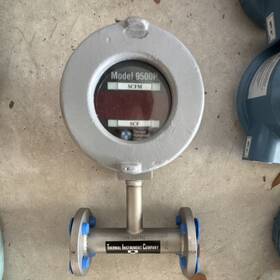
( Brand: Thermal Instrument Company ), ( Manufacturer Part Number: 600-9/9500P ), ( Part Type: Instrument ), ( Flow Meter Type: Mass Flow Meter ), ( Port Diameter: 0.5 In ), ( Minimum Flow Rate: 0 Scfm ), ( Maximum Flow Rate: 5 Scfm )
Review THERMAL INSTRUMENT COMPANY 600-9/9500p Mass Flow Meter 0.5 In 0-5 Scfm
The **Thermal Mass Flow Meter (Model 600-9/9500p)** is a high-precision, versatile instrument designed for accurate measurement of gas flow rates in industrial, laboratory, and research applications. Engineered with cutting-edge thermal dispersion technology, this flow meter operates by utilizing a heated sensing element to measure the thermal conductivity of the gas, providing real-time, contactless flow rate readings with exceptional accuracy and reliability. Ideal for a wide range of gases, including air, nitrogen, argon, helium, and other inert or reactive gases, this device features a robust construction that ensures durability in demanding environments. With a measurement range spanning from **0 to 5 standard cubic feet per minute (SCFM)**, it is perfectly suited for applications requiring precise control of low to moderate flow rates, such as laboratory gas delivery systems, process monitoring, leak detection, and calibration tasks.
The **600-9/9500p** model incorporates a **9500p digital display module**, offering a user-friendly interface with programmable settings, data logging capabilities, and configurable alarms for flow rate thresholds. This display provides clear, backlit readouts with adjustable units (SCFM, SLM, or other gas-specific settings) and supports RS-232 or USB connectivity for seamless integration with data acquisition systems, PLCs, or laboratory software. The flow meter s compact and modular design allows for easy installation in tight spaces, while its **0.5% of reading accuracy** ensures consistent performance across varying flow conditions. Built with a **stainless steel sensor assembly** and corrosion-resistant materials, this device is resistant to moisture, dust, and chemical exposure, making it suitable for both cleanroom and harsh industrial settings.
Whether used in semiconductor manufacturing, medical gas delivery, environmental testing, or research laboratories, the **Thermal Mass Flow Meter 600-9/9500p** delivers unmatched precision and flexibility. Its **self-diagnostic features** and low-maintenance design minimize downtime, while its **wide operating temperature range** (typically -20 C to 80 C) ensures reliable performance in diverse environments. By combining advanced thermal sensing with intuitive digital controls, this flow meter provides an ideal solution for applications where accuracy, repeatability, and ease of use are paramount.
### **Pros and Cons of Buying a Thermal Mass Flow Meter (Model: 600-9/9500p, 0-5 SCFM, 0.5 Accuracy)**
#### **Pros:**1. **High Accuracy and Precision** The 0.5% accuracy rating ensures reliable measurements for applications requiring precise flow control, such as gas mixing, combustion optimization, or process monitoring.
2. **Wide Flow Range (0-5 SCFM)** Suitable for low to moderate gas flow applications, making it versatile for small-scale systems without the need for multiple sensors.
3. **Thermal Technology Advantages** Thermal mass flow meters provide direct mass flow measurement (unlike differential pressure meters, which require temperature/pressure corrections), improving accuracy in varying conditions.
4. **Low Pressure Drop** Since it uses a heated filament rather than an orifice or turbine, it minimizes pressure loss in the system, reducing energy consumption.
5. **Durability and Long-Term Stability** High-quality thermal sensors are resistant to wear and drift over time, ensuring consistent performance in stable environments.
6. **Digital Output Options** Many models offer analog (4-20mA) or digital (RS-485, Modbus) outputs, allowing easy integration with PLCs, data loggers, or control systems.
7. **Compatibility with Common Gases** Works well with clean, dry gases (e.g., air, nitrogen, natural gas) without clogging issues (unlike mechanical meters).
8. **Compact and Modular Design** Fits into tight spaces and can be installed inline without significant modifications to the piping system.
9. **No Moving Parts** Unlike turbine or piston meters, thermal sensors have no mechanical components, reducing maintenance needs and failure risks.
10. **Calibration-Friendly** Can be recalibrated if needed, though high-quality units require minimal adjustment over their lifespan.
---
#### **Cons:**1. **Limited to Clean, Dry Gases** Contaminants (dust, moisture, corrosive gases) can degrade performance or damage the sensor, requiring upstream filtration.
2. **Temperature Sensitivity** While thermal meters are less affected by temperature than some other types, extreme conditions may still require compensation or correction.
3. **Higher Upfront Cost** Compared to simpler mechanical or ultrasonic meters, thermal mass flow meters are more expensive, though this is often justified by accuracy and longevity.
4. **Potential for Drift Over Time** Even with high-quality units, sensor degradation can occur with prolonged use, necessitating periodic verification.
5. **Limited to Low to Moderate Flows** The 0-5 SCFM range may be insufficient for high-volume applications, requiring a larger or multiple units.
6. **Power Dependency** Requires an external power source (typically 24V or 120V) for heating the filament, adding to system complexity.
7. **Installation Requirements** Needs straight pipe runs (typically 10-20 diameters upstream/downstream) to avoid turbulence affecting readings.
8. **Limited to Gaseous Applications** Not suitable for liquids or steam, restricting its use to gas-phase measurements.
9. **Potential for Condensation Issues** In humid environments, moisture could affect sensor performance unless proper drying is implemented.
10. **Vendor Dependency for Calibration** Some manufacturers require specialized calibration services, which may add cost or downtime.
---
### **Conclusion:**The **600-9/9500p thermal mass flow meter (0-5 SCFM, 0.5% accuracy)** is an excellent choice for applications requiring **high-precision, low-maintenance gas flow measurement** in controlled environments. Its **direct mass flow capability, durability, and minimal pressure drop** make it superior to mechanical or differential-pressure meters for many industrial, laboratory, or HVAC applications.
However, it is **not ideal for dirty, wet, or high-flow environments** without additional conditioning. If your system involves **clean, dry gases at low to moderate flows**, this meter will provide **reliable, long-term performance** with minimal calibration needs.
### **Recommendation:** - **Buy if:**- You need **accurate, repeatable measurements** for gas flow in a clean environment.
- Your application involves **low to moderate flows (up to 5 SCFM)** with minimal turbulence.
- You prioritize **low maintenance and long-term stability** over cost.
- The meter will be **protected from contaminants** (e.g., with filters or dryers).
- **Avoid if:**- Your gas contains **dust, moisture, or corrosive particles** without proper pretreatment.
- You require **high-volume flows** beyond 5 SCFM (consider a larger model or alternative technology).
- Your budget is constrained, and you can tolerate slightly lower accuracy (e.g., 1%).
- The installation lacks **proper straight pipe runs** or has extreme temperature fluctuations.
**Final Verdict:** For most **precision gas flow applications within its specified range**, this thermal mass flow meter is a **strong, cost-effective choice** provided environmental conditions are suitable. Pair it with appropriate filtration and calibration procedures to maximize its lifespan and accuracy.
Details:
Thermal Instrument Company 600-9/9500P Mass Flow Meter 0.5 in 0-5 S cfm .
part #: 60099500p prices
- $132.48-$1479.65
specifications pneumativalv:
- brand: Thermal Instrument Company
- mpn: 600-9/9500p
- part type: Instrument
- flow meter type: Mass Flow Meter
- port diameter: 0.5 In
- minimum flow rate: 0 Scfm
- maximum flow rate: 5 Scfm
shipping pneumativalv:
- cost: $8.46
- type: Calculated
- carrier: USPS
- class: Standard
- transit: 5-10 Days
- service: USPS Ground Advantage
returns pneumativalv:
- policy: No Returns
payments pneumativalv:
- money order
- wallet: Apple-pay
- credit card: Visa
- other
seller pneumativalv:
- city: Katy, Texas
- # reviews: 0
- rating: 0.0%
general pneumativalv:
- Pump Flow Controllers > Flow Controllers Meters > Flow Meters
- condition: Used
offer pneumativalv:
- best offers: True
- started: March 25, 2026
- options: Ship-to-home
- sold: 0
- availability: In Stock
- quantity: 1
Thermal Instrument Company 600-9-9500P Is Similar To:
- 0190-40282-01 Brooks Gf Mass Thermal Flow Controller Amat (28.3% similar) Used excellent condition brooks GIF 125CXC mass Thermal flow controller Amati in: 9B800-9-18...(September 7th, 2018)
- 5863i Brooks Analog Thermal Mass (23.5% similar) Lb min rate location. Preowned brooks analog Thermal mass flow sensor 5863I series n2 gas...(October 26th, 2017)
- 600-9 Thermal Instrument Co Model (48.5% similar) The packaging may show signs of wear from an extended shelf life. Model 600-9. Thermal Instrument co...(August 22nd, 2017)
- 65f25-am2a91bababa Endress Hauser Thermal Mass Flow Meter Inch (40.9% similar) We no longer need it. I do not have the original packing. This meter was never installed and has been used. Here are the details of this item: Thermal mass flow meter process pipe size 1 inch 25MM whetted parts 316 ss connection 300 pound flange internal seals peek and Vito electrical approvals TeX ...(January 23rd, 2019)
- 8669mp-sss-133-ac 115-fsw1503-a Eldridge Products Inline Thermal Mass Flow Meter (30.7% similar) Hours 8:30AM-5PM Mon-Fri eastern standard time...(July 16th, 2018)
- Gf 120c Brooks Instrument Series Thermal Mass Flow Controller Sccm Gas (45.7% similar) ...(September 29th, 2018)
- Gf040cxxc-00137.2l-n2avs4-xxxxax-70f Brooks Instruments Gf Series Thermal Mass Flow Controller (34.1% similar) No software, power cords, or other accessories are included unless stated above. 2L-N2AVS4-XAX-70F gas: air range: 3000SCCM appears to be in fair cosmetic condition, although there are a few small dings, scratches, signs of previous use. All offered products are sold as advertised, is and without ...(February 28th, 2019)
- Gf100cxxm Brooks Gf High Purity Thermal Mass Flow Controller Sccm (37% similar) Brooks GIF high purity Thermal mass flow controller h2 GF100CXM 5000 scam thumbnails to - unit powers on both leds light solid green. Power adapter and other accessories not included. Good cosmetic condition with some light signs of use wear. See images for items detailed condition. In an effort to ...(August 13th, 2018)
- Gf120c-892476 Brooks Instrument Gf Series Thermal Mass Flow Nc (39.4% similar) Brooks Instrument GIF series Thermal mass flow 120C h2 10000SCCM NC...(August 8th, 2018)
- Gf120cxxc Brooks Gf Series Thermal Mass Flow (29.8% similar) This is a brooks GIF series GF120CXC Thermal mass flow n2 5SCCM. Please first before buying on an item if you choose this method...(March 13th, 2018)
- Gf120cxxm Brooks Gf Series Thermal Mass Flow Sccm (35.3% similar) Please first before buying on an item if you choose this method. This is a brooks GF120CXM Thermal mass flow controller BF3 200 scam...(July 9th, 2018)